Pokemon
Is Buying BRG Slabs to Crack and Submit to PSA Worth It?
Key Takeaways
- Buying BRG-graded Pokémon cards and submitting them raw to PSA can sometimes create profitable arbitrage opportunities.
- BRG has earned a reputation among many collectors for consistent and conservative grading, while PSA continues to command the highest resale premiums globally.
- The opportunity exists because the market often values the label as much as the card itself.
- Success depends on accurately evaluating card condition, understanding grading risk, and leaving enough margin after grading fees and selling costs.
For years, PSA has dominated the Pokémon TCG grading market. Its slabs consistently achieve the highest prices, enjoy the greatest liquidity, and are the grading company of choice for many serious collectors and investors.
However, another grading company has quietly developed a strong reputation in South Korea: Break Grading (BRG).
Although BRG cards typically sell for less than equivalent PSA grades, many collectors believe BRG’s grading standards are more conservative in certain areas. Whether that perception is objectively true is difficult to prove, but it has created an interesting market inefficiency.
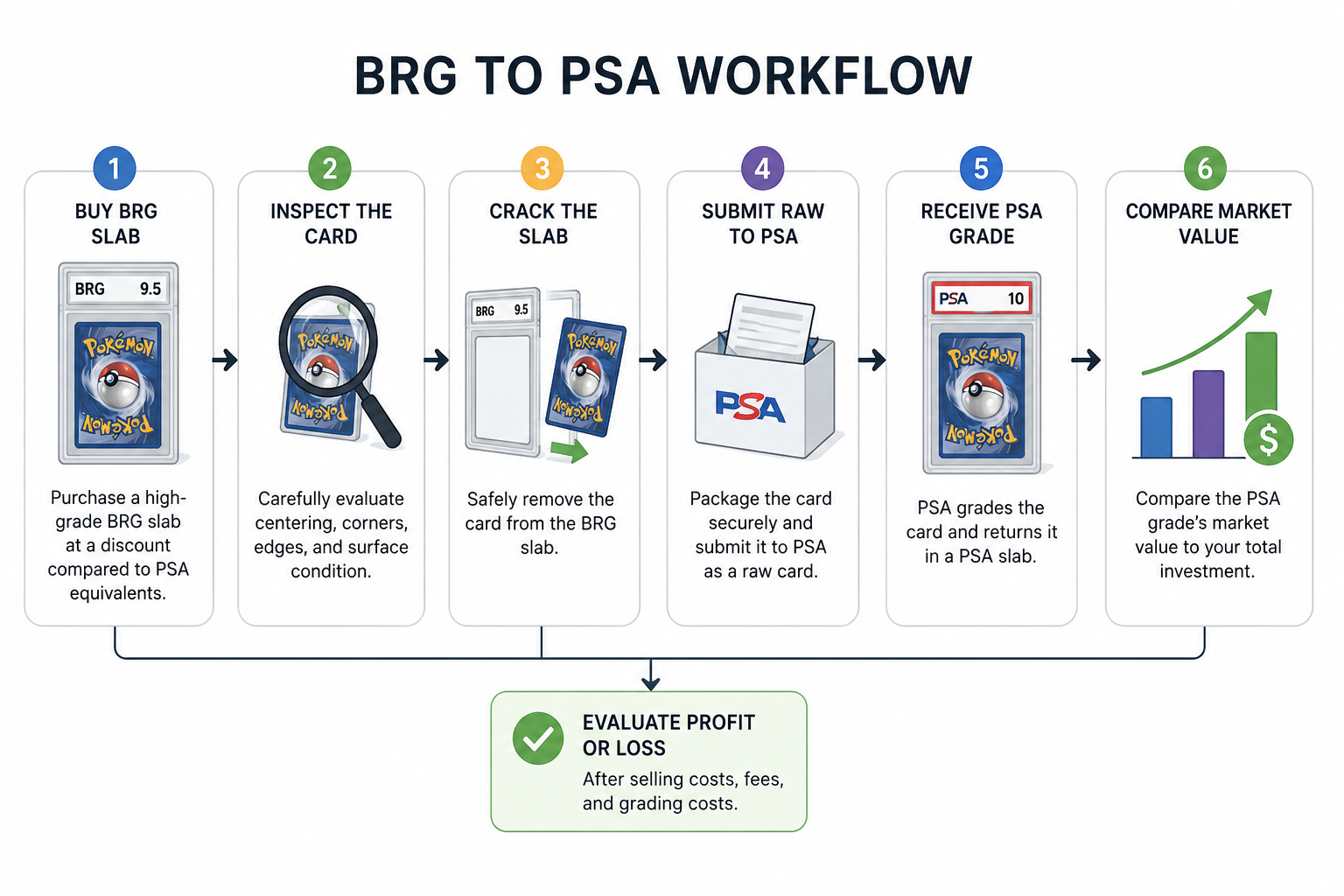
Some collectors now actively buy high-grade BRG slabs, crack them open, and submit the cards to PSA in hopes of receiving a higher-value grade.
The question is whether this strategy actually works—and more importantly, whether it’s profitable.
What Is BRG?
Founded in 2021 by Break & Company, Break Grading (BRG) has become one of South Korea’s leading trading card grading services.
The company grades Pokémon, Yu-Gi-Oh!, Magic: The Gathering, One Piece, sports cards, and K-Pop photocards, offering collectors a domestic alternative to overseas grading companies like PSA and Beckett.
BRG combines experienced graders with modern authentication technology, including Video Spectrum Cameras (VSC), to help detect counterfeits and identify microscopic defects that may not be visible under normal inspection.
Cards are evaluated across the four standard grading categories:
- Centering
- Surface
- Edges
- Corners
The finished cards are sealed inside premium tamper-resistant slabs featuring QR code verification and bilingual label options.
Why Do BRG Cards Usually Sell for Less?
This isn’t necessarily because collectors believe BRG grades are less accurate.
Instead, it comes down to market recognition.
PSA has spent decades establishing itself as the world’s largest trading card grading company. Its registry system, auction history, worldwide acceptance, and enormous collector base create demand that few grading companies can match.
As a result, two identical cards in similar condition may sell for very different prices simply because one is in a PSA holder.
For many buyers, they’re paying a premium for confidence, liquidity, and familiarity—not just the condition of the card.
Is BRG Stricter Than PSA?
This is one of the most debated topics among collectors.
Many hobbyists who regularly buy both PSA and BRG slabs believe BRG is generally more conservative when awarding top grades, particularly when it comes to centering and surface quality.
That does not mean every BRG 9.5 will become a PSA 10, nor does it mean BRG is objectively “harder” than PSA. Grading remains subjective, and there is no official conversion between grading companies.
However, the perception alone has created an opportunity.
If a collector believes a BRG-graded card is stronger than its assigned grade—or that it meets PSA’s grading standards—they may choose to remove the card from its slab and submit it as a raw card.
Why Collectors Submit Raw Instead of Using PSA’s Crossover Service
Most collectors pursuing this strategy do not use PSA’s crossover grading service.
Instead, they carefully crack the BRG slab, remove the card, and submit it as if it had never been graded.
The reasoning is simple.
A raw submission allows PSA graders to evaluate the card without seeing another company’s assigned grade.
Whether this results in better outcomes is largely anecdotal, but raw submissions are widely preferred by collectors attempting this strategy.
The Opportunity Isn’t the Grade—It’s the Price Gap
The strategy works because of arbitrage.
If a BRG-graded card sells significantly below the market value of an equivalent PSA grade, there may be room for profit after grading costs.
For example, imagine:
| Cost | Example |
|---|---|
| Purchase BRG slab | $450 |
| Shipping & grading | $40 |
| Total investment | $490 |
| PSA 10 market value | $700 |
| Potential gross profit | $210 |
This is only a simplified example. Actual profits depend on current market prices, grading fees, taxes, marketplace fees, and the final PSA grade.
The key isn’t finding cheap BRG slabs.
It’s finding underpriced cards that genuinely appear capable of achieving the desired PSA grade.
How to Evaluate a BRG Slab Before Buying
Experienced collectors buy the card—not the label.
Before purchasing, inspect high-resolution images for:
- Centering
- Corner whitening
- Edge wear
- Surface scratches
- Print lines
- Factory dents
- Silvering
- Overall eye appeal
Even if the slab carries a high grade, the underlying card still needs to satisfy PSA’s grading standards.
One overlooked defect can eliminate any potential profit.
The Biggest Risks
Like any investment strategy, this approach carries significant risks.
These include:
- PSA assigning the same grade
- PSA assigning a lower grade
- Damaging the card while cracking the slab
- Market prices falling during the grading turnaround
- Submission costs reducing profit margins
- Long grading turnaround times
Even experienced collectors occasionally lose money on resubmissions.
Who Should Consider This Strategy?
This strategy generally suits collectors who:
- Can accurately evaluate raw card condition.
- Understand PSA grading standards.
- Follow recent market prices closely.
- Leave enough margin for grading costs and selling fees.
- Are comfortable accepting occasional losses.
It is not a guaranteed way to make money.
Success comes from disciplined buying rather than hoping every BRG slab upgrades at PSA.
Final Thoughts
Buying BRG slabs to crack and submit to PSA is one of the more interesting arbitrage opportunities in the Pokémon TCG market today.
The opportunity exists because PSA continues to command the highest resale values worldwide, while BRG slabs often trade at a discount despite their strong reputation among collectors. This pricing gap occasionally allows knowledgeable buyers to unlock additional value by purchasing well-priced BRG slabs and submitting the underlying cards to PSA.
However, the strategy is far from risk-free. Every submission involves grading uncertainty, submission costs, and the possibility that the card receives the same—or even a lower—grade than expected.
For experienced collectors who can accurately judge condition and remain disciplined with their purchases, the occasional opportunity does exist. But as with any grading strategy, profitability depends on buying the right card at the right price—not simply cracking every BRG slab in sight.